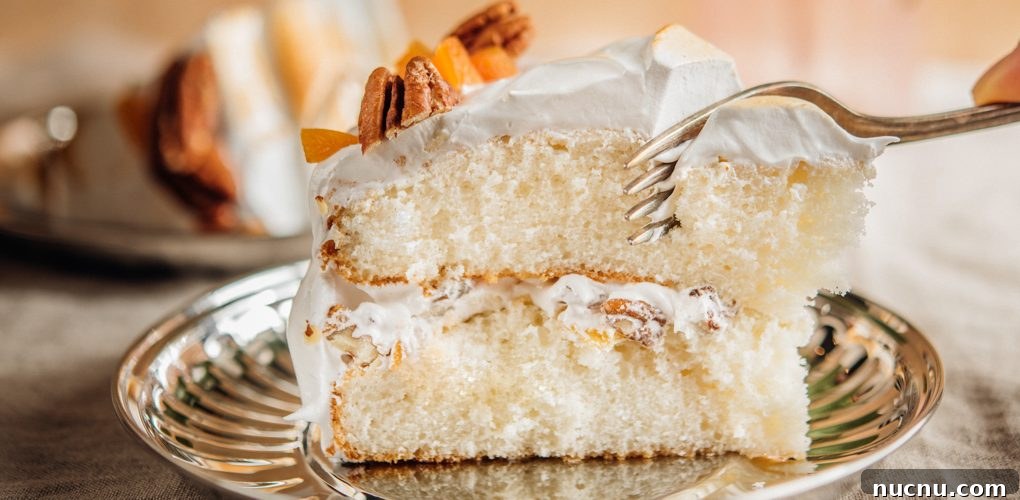
Cake flour is milled finer and feels softer to the touch, producing a delicate, even crumb in cakes. It is made from fine, soft winter wheat rather than the harder spring wheat commonly used for all-purpose flour. At Swans Down, our cake flour is refined further by sifting it repeatedly—creating an exceptionally light, uniform texture.
Among flours, cake flour has one of the lowest protein (gluten) levels and the highest starch proportion. Lower gluten yields a tender, airy crumb—ideal for cakes—because gluten gives dough stretch and chew, which is useful for breads but counterproductive when the goal is a soft, melt-in-your-mouth cake.
Enjoy this slice of cake-flour science.
Rose Levy Beranbaum, one of America’s most respected baking authorities, explains several important effects of cake flour in her classic guide, The Cake Bible (1988). Her observations clarify why cake flour behaves differently from other flours and how those differences affect final results.
- Because cake flour is more finely milled, it absorbs fat and moisture more readily than coarser flours made from hard spring wheat. The size and distribution of gas cells in a baked cake determine the quality of the crumb, and these cells form as the batter expands during baking. How far the batter can expand before the cell walls rupture depends on the size of the flour particles, the batter’s pH, and the type of shortening used. Finer particles promote a finer, more even grain in the finished cake.
- Bleaching by chlorination lowers the pH of cake flour compared with unbleached or less-treated flours. The increased acidity contributes to a sweeter perceived flavor and a velvety, finer crumb because proteins coagulate at a lower temperature. As a result, cake structure can better support higher proportions of sugar, butter, and heavier mix-ins such as chopped nuts or chocolate without collapsing.
Can I substitute other flours for cake flour?
The brief answer is: sometimes, but with caution. Baking depends on precise proportions and ingredient characteristics. Cake flour typically contains about 6% protein. If you substitute a flour with significantly higher protein—10% or 12% in some all-purpose flours, or 14–15% in bread flours—you will likely change the cake’s texture, making it denser or chewier than intended.
There are home-method substitutes that can mimic cake flour’s lower protein and finer texture, such as replacing a portion of all-purpose flour with cornstarch and sifting the mixture thoroughly. These approaches can work in a pinch for many recipes, but they won’t always replicate the exact behavior of true cake flour, especially in delicate or technically demanding recipes. For consistently light, fine-textured cakes, experienced bakers generally recommend using genuine cake flour when a recipe specifies it.
If you must substitute, consider the recipe’s sensitivity to texture and structure. Recipes that rely heavily on a fragile, tender crumb—layer cakes, chiffon cakes, and some sponge cakes—will show the greatest difference when a higher-protein flour replaces cake flour. Conversely, more rustic or dense cakes may tolerate substitutions with less noticeable change.
In summary, cake flour’s fine milling, lower protein content, and specific treatment produce a distinct combination of absorption, acidity, and protein behavior that favors very light, tender cakes. When a recipe calls for cake flour, using it will most reliably deliver the texture and flavor the baker intended.