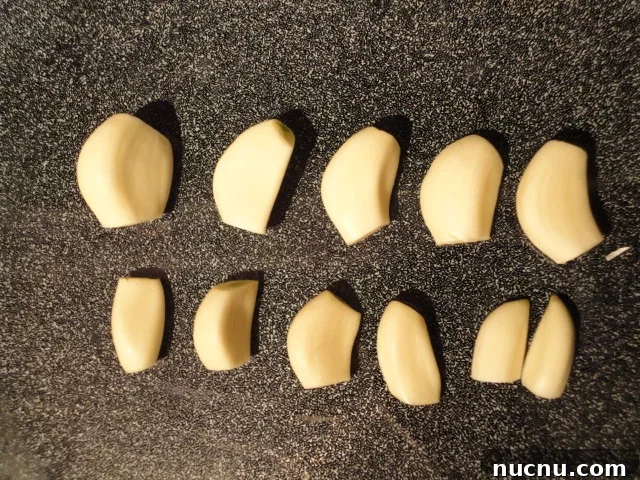
Garlic Cloves of Different Sizes
I love garlic in all its forms: slowly browned whole in a marinara, thinly sliced and sautéed with anchovies and olive oil before being tossed with pasta, stir-fried with broccoli, or rubbed raw on toast and paired with steak tartare. Its aroma, flavor, and versatility make garlic a constant in my kitchen.
Garlic (Allium sativum) belongs to the same genus as onions, shallots, leeks, and chives. While there are two subspecies of true garlic, “elephant garlic” isn’t one of them—it’s actually a wild leek (Allium ampeloprasum), and not a true garlic at all.
Even with my fondness for garlic, I recognize when a dish has been overpowered by it. Recipes frequently call for “4–6 cloves,” but that instruction leaves room for confusion: how large is a clove? Do cooks assume a standard size, or is it left to personal taste? The photo above shows 11 cloves I recently used, arranged from largest (top left) to smallest (bottom right), and it clearly demonstrates how much garlic clove size can vary.
That variation raises practical questions: when a recipe lists a number of cloves, is there an assumed average weight or volume? Should cooks measure garlic by weight or by size to achieve consistency? How does preparation—whole, sliced, minced, crushed, dried, or powdered—affect potency and the final flavor of a dish?
My own observations are informal rather than scientific, but they highlight an important point for anyone following recipes: “clove” is an imprecise unit. If you want predictable results, especially when cooking for others or scaling recipes, consider measuring garlic by weight or adjusting based on how the garlic will be used. A single large clove can be markedly more pungent than a small one, and minced or crushed garlic will release more aromatic compounds than a whole roasted clove.
In the end, personal preference plays a major role. If you enjoy a pronounced garlic character, err on the higher side of the clove count or use larger cloves; if you prefer subtler notes, use fewer or smaller cloves, or opt for roasted or whole cloves to mellow the flavor. Awareness of clove size and preparation method can help you better translate a recipe into a dish that matches your taste.
This simple, unscientific experiment opened my eyes to the nuances of potency, volume, and measurement when it comes to garlic and similar aromatics—issues that matter whether a recipe calls for whole, sliced, minced, dried, or fresh forms.